
Baraga Correctional Release Routes
Baraga Correctional Facility, commonly identified by the code AMF, is an MDOC state prison. It is not the county jail. A person held there may have been sentenced by a court anywhere in Michigan. The Baraga County Sheriff does not set or verify the person’s prison release date and does not hold the AMF discharge record.
Leaving AMF can mean parole into the community, maximum discharge, a court-ordered release, or movement to another MDOC facility. A parolee has left the institution but remains under MDOC legal custody and control. A discharged person has reached the end of the sentence or successfully completed parole. A transfer remains a prisoner movement.
| AMF event | Custody meaning | Primary check |
|---|---|---|
| Parole | Physical prison release with state supervision | OTIS, parole order, linked field office |
| Maximum discharge | Sentence and MDOC supervision end | OTIS and discharge order |
| Court-ordered release | A court changes the legal basis for custody | Court order and MDOC record |
| MDOC transfer | Prison custody continues at another location | Updated OTIS location |
Note: A location change from AMF is not a release unless the status and official record show departure from prison custody.
Confirm Baraga Correctional Release
The official Offender Tracking Information System is the first person-level check. Use the six-digit MDOC number when known. Otherwise, search by name and add only the refinements needed to distinguish records. Choose “All” when the person may be a prisoner, parolee, probationer, discharged person, or absconder. Choose “Discharged” when specifically checking a completed MDOC sentence.
- Open OTIS and accept its disclaimer.
- Search by MDOC number or a carefully matched name.
- Open the blue offender number for the full detail.
- Read status, current location, sentence entries, and all labeled dates together.
- Use the location link for a prison or supervising-office contact.
- Request the formal order when exact legal proof is required.
OTIS does not show a guaranteed “projected release date.” Earliest Release Date is generally a parole-eligibility marker, while Maximum Discharge is the outside sentence endpoint.
A Date Paroled marks acquisition of parole status. “Discharged” means MDOC supervision ended. The Baraga County release-record paths explain why these state fields must not be mixed with a county jail release time.
Baraga Correctional Facility Details
The official MDOC facility profile lists Baraga Correctional Facility at 13924 Wadaga Road in Baraga. It opened in 1993, houses adult men, and includes security levels I and V. The official profile is the right source for current facility identity and contact details.
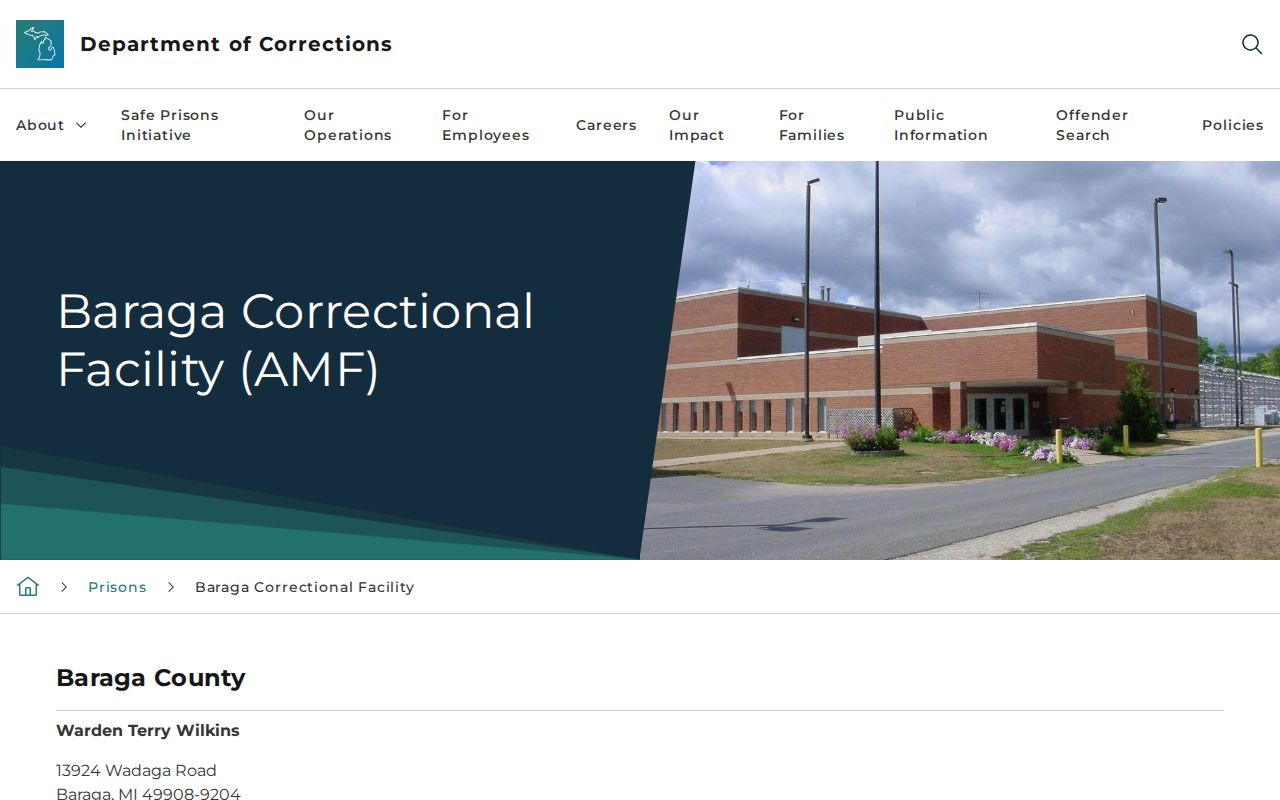
The profile confirms the state-prison operator and keeps the AMF record path separate from the Sheriff-operated county jail.
Baraga Correctional Facility (AMF)Michigan Department of Corrections
13924 Wadaga Road
Baraga, MI 49908-9204
906-275-5100
mdoc-baraga-public@michigan.gov
The researched profile names Warden Terry Wilkins. Leadership can change, so use the official facility page for current staff. General facility contact can clarify location and routing, but a formal discharge or parole document belongs with the proper MDOC records channel.
Baraga Prison Parole Releases
The Michigan Parole Board is the sole paroling authority for felony offenders committed to MDOC. Reaching the Earliest Release Date does not itself order release. The Board may grant parole, deny it, or continue consideration. Even a grant requires release processing and an approved placement before the institutional exit occurs.
The MDOC Parole Release Unit coordinates placement and timely release after a positive decision.
Its role explains why a favorable parole decision and the actual AMF departure can occur at different stages.
Public Parole Board hearings are limited to published proceedings, often parole-eligible lifer or clemency matters. A clemency hearing does not itself release a prisoner. MDOC has no verified person-level public decision database. OTIS is the practical after-action status check, while a formal record request can seek the applicable order.
Michigan Parole BoardPO Box 30003
Lansing, MI 48909
517-373-0270
Parole-Board-Staff@michigan.gov
Monday-Friday, 8 a.m.-5 p.m.
Baraga Correctional Release Records
OTIS is a public status tool, not a certified discharge packet. For a formal AMF release record, use the MDOC FOIA process. Identify the person by MDOC number and name. State a reasonable date range and request only the documents needed, such as the Basic Information Sheet, judgment, parole order or status history, discharge certificate or order, and available offender photograph.
MDOC distinguishes current-prisoner records from past-prisoner routing. Its contact directory accepts past-prisoner inquiries up to six years after release. Computerized records date to 1980; older archival inquiries go to the Archives of Michigan. OTIS itself displays discharged people for three years after supervision ends. Those are access and display windows, not proof that every underlying record was destroyed.
MDOC FOIA CoordinatorPO Box 30003
Lansing, MI 48909
MDOC-FOIA@michigan.gov
517-335-4194
Fax: 517-335-4193
MDOC describes paper copies at ten cents per page, plus actual mailing and permitted labor when applicable. A response may redact exempt material. The comprehensive PENPACK discussed in MDOC’s FAQ is restricted to recognized criminal-justice authorities for official business and should not be requested as a general public packet.
A focused request should distinguish institutional release from sentence discharge. Ask for the parole order when the person left prison on supervision, and ask for the discharge order or certificate when MDOC authority ended. A Basic Information Sheet and judgment can supply the identity and sentence context. If the public status page and a formal order differ, use the dated agency document and ask the responsible MDOC records unit to explain the record path rather than combining the fields into a generic release date.
Record age changes the route. MDOC directs recent past-prisoner questions to its retention contact, older computerized history through the formal records process, and pre-1980 archival material to the Archives of Michigan. The three-year public display period for discharged people is narrower than those records routes. Therefore, an absent public result does not prove that no AMF release or discharge record exists.
Baraga Prison Release Notifications
MI-VINE can provide general release notice for MDOC prisoners. Select Michigan in VINELink, locate the person with a name and MDOC number when available, verify the feeding agency, and register for the correct record. A release alert is an agency-fed event, not a certified historical document. Delays can occur between the underlying event and the alert.
Phone registration uses a four-digit PIN. Enter the PIN and pound key when the call arrives to acknowledge it. Email and text do not use that phone PIN. Qualifying direct victims who need broader state-prison events, including parole-related notice beyond general VINELink release alerts, must separately register with MDOC Crime Victims Services at 877-886-5401.
- Parolee
- A person outside prison who remains under MDOC custody and control.
- Discharge order
- The formal order ending the sentence after required supervision or maximum service.
- Transfer
- A move between facilities while MDOC prison custody continues.
- Absconder
- A supervised person whose required reporting or whereabouts is unresolved.
Baraga’s Two Release Systems
Baraga County’s local geography is unusual. A small Sheriff-operated jail and a state prison stand in the same county, but their records do not merge. Someone housed at AMF can come from any Michigan sentencing county. A person leaving Baraga County Jail may have no MDOC history at all.
Use the full facility name when asking for a record. “Baraga release” is too vague. An AMF question goes to OTIS, MDOC records, the Parole Board process, and MI-VINE. A Baraga County Jail question goes to the Sheriff, local court, county FOIA, and any county-fed MI-VINE event. This simple custody-system choice prevents the most common local search error.
The distinction also protects the meaning of each date. The county jail records the end of one local booking. MDOC may publish an Earliest Release Date, Maximum Discharge, Date Paroled, and later discharge information for a state sentence. Those fields answer different questions. A person paroled from AMF has physically left prison but remains in state legal custody, while a transfer to another MDOC facility does not end prison custody at all.
Custody After an AMF Release
Departure from AMF does not always prove an unrestricted community return. Parole brings continuing MDOC supervision. A court order may interact with another sentence or hold. A transfer keeps the person in state prison. When the record identifies another custodian, follow that agency’s record rather than relying on the vanished AMF location.
An ICE detainer is a request for notice and custody so immigration authorities may assume control for a limited period after the person would otherwise be releasable. If an official record identifies ICE involvement, use the ICE locator promptly because its recent released-record window is limited. No publicly documented ICE detention center was found in Baraga County. The point is the custody handoff, not a local ICE facility.
The same source-label rule applies to a court-ordered change. The court record establishes the legal order, while MDOC records establish how the department implemented it. A favorable parole decision also needs release processing and placement before an institutional departure. When exact proof matters, retain the status result, the formal order, and the date each source was checked. That record trail prevents a decision date from being reported as the physical release date.
Note: A parole date, discharge date, court order, and transfer date are distinct fields and should always retain their source labels.