
Baraga County Parole Versus Probation
Parole is permission to leave a Michigan prison under conditions before the sentence ends. Under MCL 791.238, a parolee remains in MDOC legal custody and control. A person released from Baraga Correctional Facility may therefore live in the community while still listed as a parolee. Probation is different. It is imposed by a court and supervised in the community. Someone can receive probation after a county-jail term, after time served, or without ever entering state prison.
The agency path follows that distinction. The Michigan Parole Board decides parole for felony offenders committed to MDOC. A field agent manages active parole or probation supervision shown in OTIS. The sentencing court controls the probation order and later court action. Baraga County Jail staff can confirm that a local booking ended, but the jail does not decide state parole or maintain the full supervision record.
| Point | Parole | Probation |
|---|---|---|
| Starting point | Release from an MDOC institution | Sentence entered by a court |
| Decision maker | Michigan Parole Board | Sentencing judge |
| Public status route | OTIS Parolees filter | OTIS Probationers filter and court record |
| End point | Board order of discharge or sentence maximum | Court-ordered completion or discharge |
- Discharge
- The formal end of the sentence and supervision.
- Absconder
- A person whose supervision remains active while required reporting or whereabouts are unresolved.
- Field office
- The MDOC office responsible for day-to-day community supervision.
Verify Baraga County Post-Release Supervision
The official starting point for an MDOC case is the Offender Tracking Information System, known as OTIS. It covers current Michigan prisoners, parolees, probationers, absconders, and people discharged within the public display window. It does not cover a person whose only sentence was in a county jail. Use the MDOC number when known because it is the most exact key. If the status is uncertain, choose All rather than guessing.
- Search OTIS by the six-digit MDOC number or by last and first name. Use added identity fields only to separate similar records.
- Open the blue offender number and read status, sentence entries, dates, and location together. Do not rely on a name alone.
- Select the linked location to identify the responsible parole or probation field office. The person’s residence does not prove which office handles the case.
- For probation imposed in a Baraga case, compare OTIS with the 97th District or 12th Circuit Court register and the actual probation order.
- Contact the linked office for current supervision confirmation. Ask the court about court-set conditions and the Board about parole decisions.
The Baraga County released-inmate lookup explains the separate Sheriff, court, and state-prison routes when the prior custodian is unclear. For a jail-only booking, start with the Sheriff and court instead of OTIS.
Baraga County Supervision Status Fields
OTIS offers status choices for Parolees, Probationers, Parole Absconders, Probation Absconders, Discharged, Prisoners, Active Offenders, and All. A detail may also show the MDOC number, linked location or supervising office, sentence data, Date Paroled, Earliest Release Date, Maximum Discharge, and a photo when available. Each field answers a narrow question. Earliest Release Date is not proof that parole began, and a location link may identify an office rather than a prison.
| OTIS field | What it can establish |
|---|---|
| Parolee | The person is outside prison under active MDOC parole control. |
| Probationer | The person is serving an active community sentence supervised by MDOC. |
| Date Paroled | The date parolee status was acquired, not the final discharge date. |
| Location | The prison or field office linked to the current MDOC status. |
| Discharged | MDOC supervision has ended, subject to record accuracy and display limits. |
The official MDOC parole and probation office directory supplies the statewide fallback when an OTIS location is unclear. The captured directory view below shows the correct route for finding an office. It is not a person-level status result.
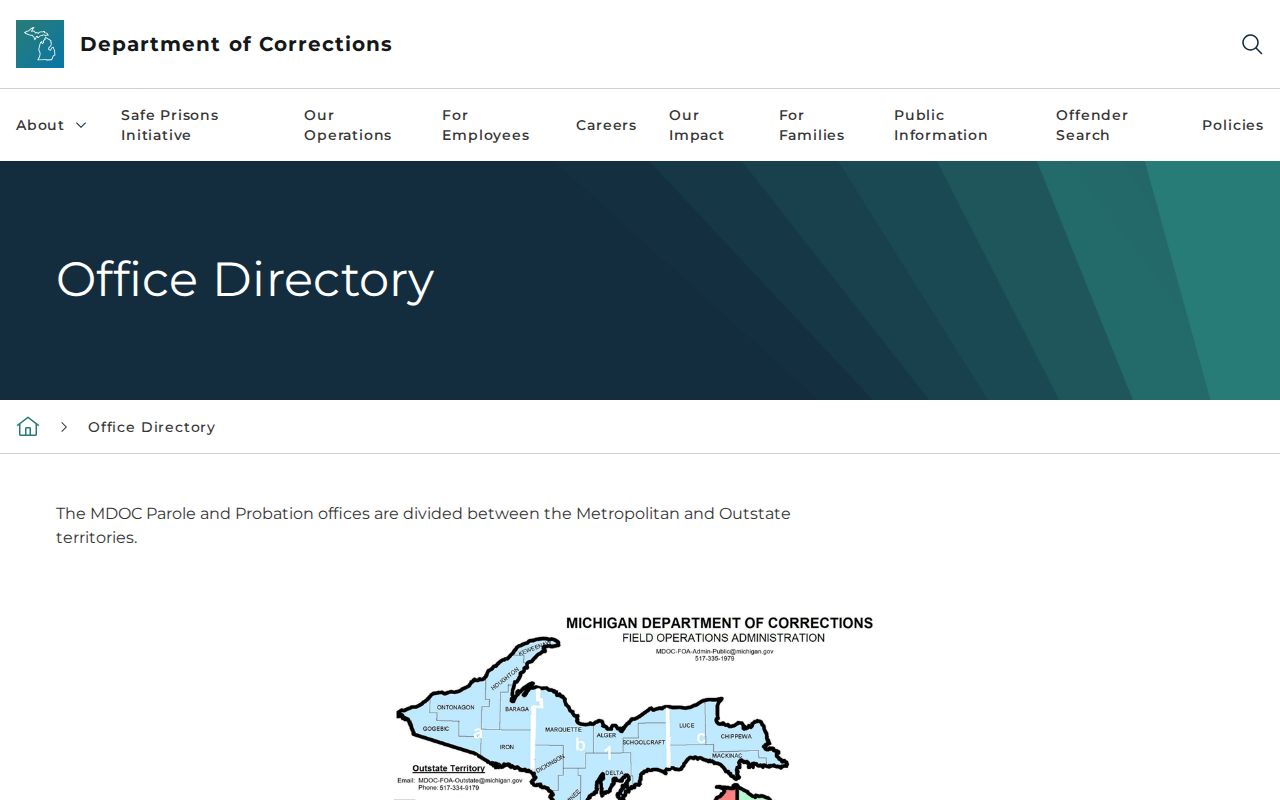
Use the office found on the person’s live record whenever possible, then verify the office name and phone in the directory.
Note: OTIS retains discharged records publicly for only three years after supervision ends, so an older absence needs a records fallback.
Baraga County Supervision Office Roles
Three state functions are easy to confuse. The Michigan Parole Board is the sole paroling authority for felony offenders committed to MDOC. The Parole Release Unit coordinates placement and timely institutional release after a positive Board decision. The linked field office handles active reporting and supervision. A positive decision is not the same as walking out of the prison gate, because placement and release processing still must be completed.
Michigan Parole Board
PO Box 30003
Lansing, MI 48909
517-373-0270
Parole-Board-Staff@michigan.gov
Monday through Friday, 8 a.m. to 5 p.m.
The Board is the right contact for its decision process, not for routine field reporting. For active supervision, use the office linked from OTIS or the directory. A Baraga County address alone does not prove that one specific field office has the case. Interstate placement, a move, or another county’s sentence can change assignment.
Correct Baraga County Supervision Records
A disputed supervision record must go to the office that created the disputed fact. This is a key Michigan distinction. Court-derived conviction, judgment, sentence, and credit facts should first be raised with the sentencing court. Active supervision facts, an office assignment, or an absconder classification belong with the linked parole or probation office. Set-aside documents go through MDOC Records Administration so staff can verify the court action before an OTIS record or image is removed.
Sending every issue to one generic address can delay a correction. First mark the exact field at issue and note its source. Compare the OTIS detail with the court register and formal order. If the court data are wrong, obtain the corrected or certified court document. If OTIS still differs after the source record is fixed, contact the appropriate MDOC unit with the MDOC number and the source document. The MDOC FAQ explains these routing differences and the set-aside verification process.
Note: A missing OTIS result may reflect spelling, system scope, a set-aside, or the discharge display window rather than a data error.
Baraga County Absconder Supervision Status
OTIS has separate Parole Absconder and Probation Absconder filters. That status is not a successful discharge. It means supervision is still active and required reporting or whereabouts are at issue. A person can be outside an institution yet remain subject to supervision and enforcement. Read the exact status, location, and sentence fields before drawing a conclusion from physical absence.
MDOC lists an Absconder/Escapee Tip Line at 517-755-0855 for actionable location information. It is not a general records or status line. Routine questions belong with the office linked from the OTIS record. If immediate safety or a known warrant is involved, contact law enforcement. The public record may identify an absconder category, but it does not publish all confidential conditions or the full violation file.
MI-VINE serves a different purpose. It can provide supported custody-event notifications from a participating source. It does not replace the supervising office, prove that supervision ended, or provide every supervision change.
Baraga County Parole Hearing Checks
Ordinary parole interviews are not all public. MDOC posts certain public hearings, often for parole-eligible lifers or clemency matters, through current notices and registration materials. Notices generally appear about two weeks to 30 days before a hearing. Registration closes two business days before the event. Current proceedings use Microsoft Teams, and MDOC prohibits recording, photography, and screenshots.
A public clemency hearing does not release a person. The Board makes a recommendation, while the Governor makes the final clemency decision. Michigan also has no verified public person-level database of parole decisions. Quarterly Parole Board Decisions Reports provide aggregate statistics, not a named person’s outcome. After a hearing, check OTIS for a status or date change and request the formal record when proof is needed.
The official MDOC hearing notice and registration page shows the current public process.
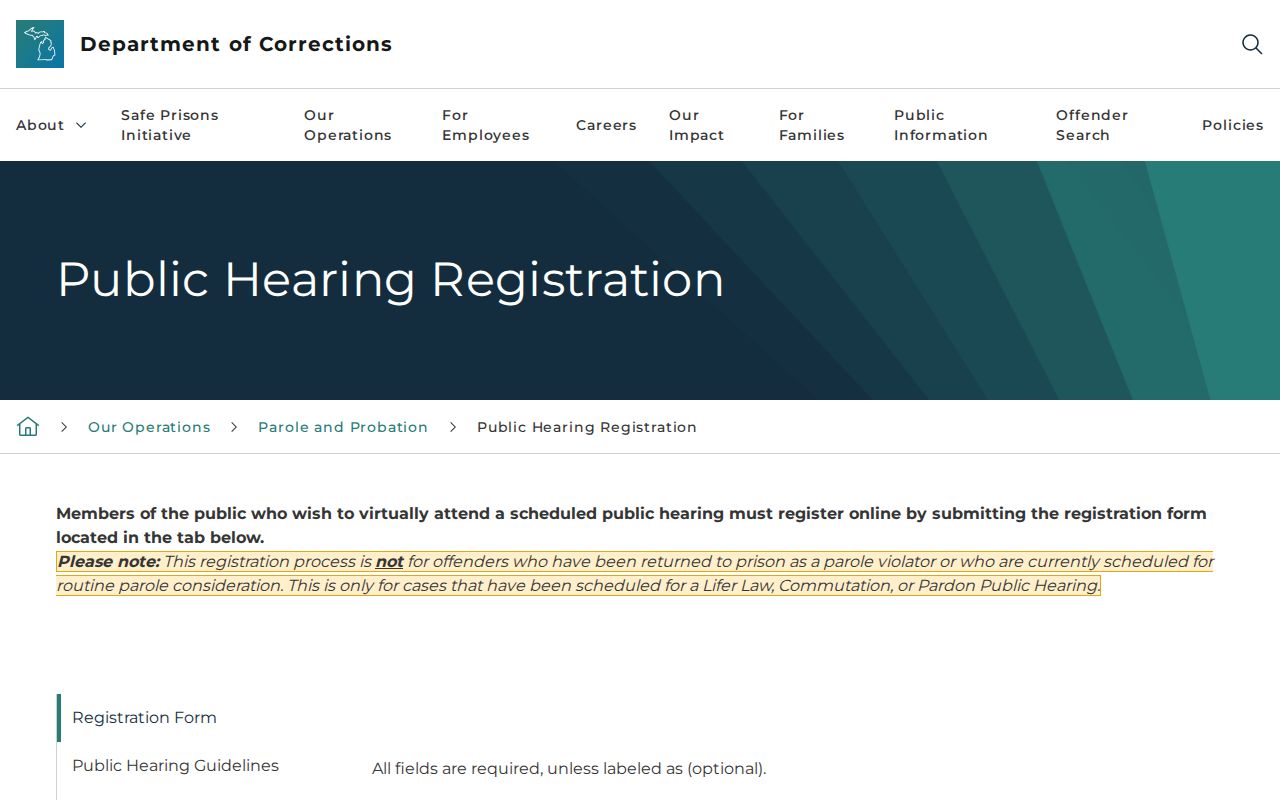
The notice page identifies scheduled public proceedings, but OTIS and formal Board records remain the person-level verification paths.
Ending Baraga County Post-Release Supervision
Parole ends through a formal discharge, not merely because a person has spent time in the community without a known issue. MDOC Policy Directive 03.01.135 provides for a Parole Board Order for Discharge from Sentence after successful completion of the ordered parole period. Maximum discharge may also end the sentence when the lawful endpoint arrives. OTIS may then show Discharged, but the formal order is the stronger record.
Probation completion follows the sentencing court’s order and any later order that closes or changes supervision. The court register can show completion-related action, while the supervising office can confirm the active status. When exact proof matters, request the discharge order, relevant judgment, and status history from the correct custodian. Do not treat the passage of a projected date, an old hearing notice, or absence from a prison as discharge.
Michigan’s system therefore has a clear sequence: prison release can begin parole, supervision continues through the field office, and a formal discharge ends the sentence. Keeping those events separate prevents a released person from being mislabeled as fully discharged.