
Baraga County Release Date Labels
A projected date estimates a possible future event. An actual release date records the end of one agency’s physical custody. A discharge date marks the end of a sentence or supervision. These labels cannot be swapped. For a person at Baraga Correctional Facility, OTIS uses Earliest Release Date and Maximum Discharge. It does not promise a single guaranteed projected release date. Earliest Release Date normally marks when the Michigan Parole Board can first obtain jurisdiction. Maximum Discharge is the outside sentence endpoint if release does not occur earlier.
County-jail dates work differently. The court judgment, time-served credit, concurrent or consecutive terms, bond activity, and separate holds affect the Baraga County Jail calculation. A pretrial detainee has no sentence-based date. The person may leave after a qualifying bond or court order, but only after all holds and jail processing clear. A court order authorizes an action; it does not by itself prove the person passed out of the jail.
| Date or status | Meaning | Best source |
|---|---|---|
| Earliest Release Date | First parole-eligibility marker, not a promised exit | OTIS |
| Maximum Discharge | Outside MDOC sentence endpoint, subject to lawful change | OTIS and formal record |
| Date Paroled | Date a person acquired parolee status | OTIS or parole order |
| Jail release date/time | End of a specific county booking or transfer event | Sheriff release record |
| Discharged | MDOC sentence and supervision have ended | OTIS and discharge order |
Find Baraga County Release Dates
First identify whether the person was held only by the Sheriff or committed to MDOC. OTIS expressly excludes county-jail-only cases. A person at Baraga Correctional Facility is in the statewide prison system and may have been sentenced anywhere in Michigan. A person in Baraga County Jail may never appear in OTIS. Using the wrong system can turn a valid no-result into a false conclusion.
- For an MDOC prisoner, open the OTIS search. Use the six-digit MDOC number when known, or search by name and careful identity refinements.
- Select All if the current status is uncertain. Open the offender number and read status, location, sentence entries, Earliest Release Date, and Maximum Discharge together.
- For a county-jail sentence, obtain the judgment and jail-credit entries from the 97th District or 12th Circuit Court record. Ask the jail for its recorded calculation.
- For a pretrial booking, read the bond and court orders, then ask the jail whether every hold cleared. Do not apply a sentence formula.
- When legal proof is needed, request the Sheriff release record, MDOC Basic Information Sheet, judgment, parole order, or discharge certificate from the right custodian.
The full Baraga County release-record search helps distinguish a jail release, state-prison event, court authorization, federal result, and immigration handoff. Those systems use different date fields.
Baraga County OTIS Release Dates
OTIS covers current prisoners, parolees, probationers, and people discharged within the last three years. Search fields include last name, first name, offender number, sex, race, age, status, and marks, scars, or tattoos. The MDOC number is the strongest public key. Search spelling matters. If a record is missing, try All status and verify the name before assuming the person is outside MDOC scope.
A detail may show a photo, MDOC number, status, location, sentence information, Earliest Release Date, Maximum Discharge, and parole or discharge information. Availability varies. Read the status first. A Prisoner result with an Earliest Release Date is not yet a parole release. A Parolee result shows institutional release with continuing state legal custody. Discharged shows the supervision end, subject to the display window and record accuracy.
The official OTIS form and status filters appear in the captured view below.
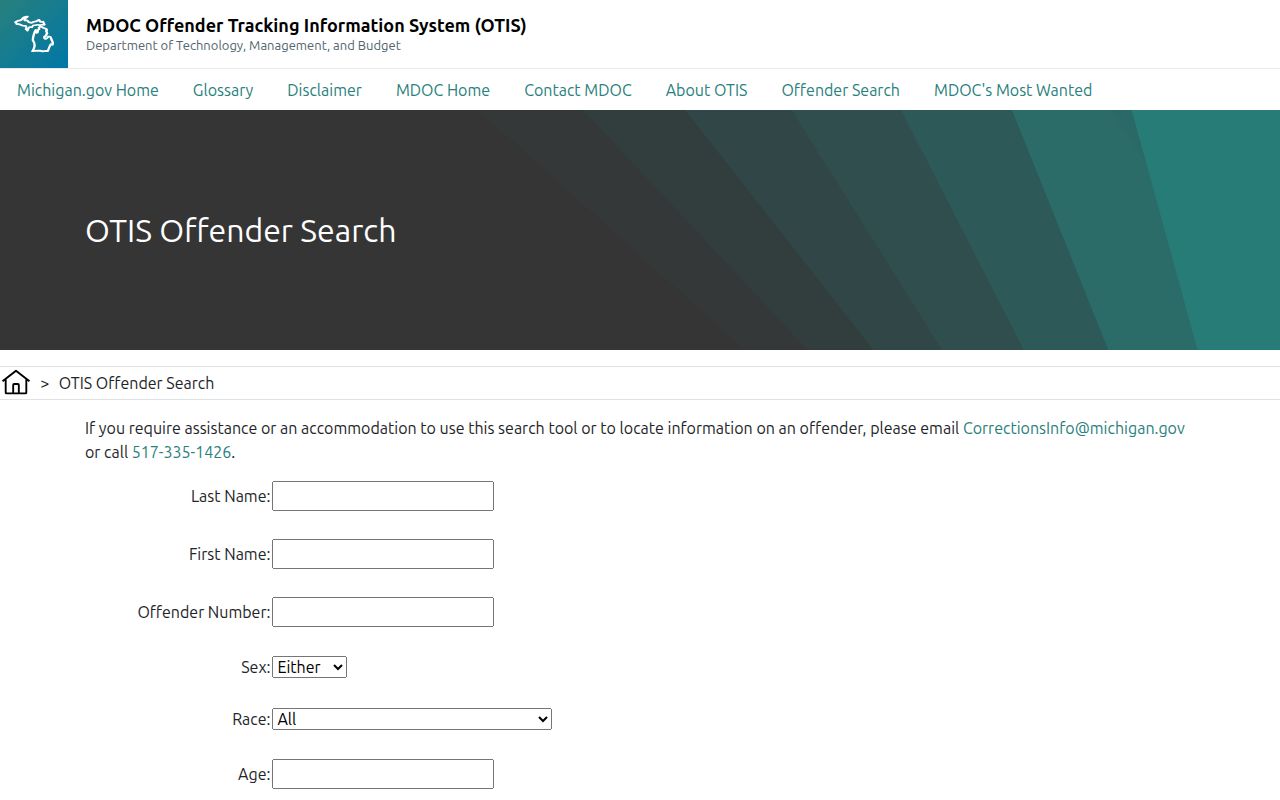
The form’s status choices let a reader distinguish a prisoner, parolee, probationer, absconder, and discharged record before interpreting a date.
Note: OTIS warns about accuracy, timeliness, and completeness, so request the formal source document when a date carries legal significance.
Baraga County Truth-in-Sentencing Dates
Michigan does not use a general rule that every modern prisoner serves 85 percent. For covered modern sentences, truth in sentencing requires service of the full judicial minimum before parole consideration. It applies to specified assaultive crimes committed on or after December 15, 1998, and all other crimes committed on or after December 15, 2000. Parole consideration at the minimum is not guaranteed release at the minimum.
MCL 791.234 governs Parole Board jurisdiction and the role of credits that remain legally applicable. MCL 791.233b prevents a prisoner subject to disciplinary time from parole before serving the minimum and requires that disciplinary time be considered. MCL 800.34 supplies the disciplinary-time framework.
Older eligible sentences may involve good time or disciplinary credits under MCL 800.33. Those legacy rules should not be copied onto a modern truth-in-sentencing case. The sentencing date, offense, judgment, and applicable statutes must be checked before any credit is used in a calculation.
Why Baraga Dates Are Not 85%
This Michigan rule is a distinctive source of bad release estimates. A quick percentage calculation can produce a date that does not exist in the official record. OTIS instead names two markers: Earliest Release Date and Maximum Discharge. The first is generally a parole-eligibility point. The second is the sentence endpoint if release does not occur sooner. Neither label should be shortened to “the release date.”
For an eligible older sentence, lawful credits may affect when Board jurisdiction begins. For a modern covered sentence, good conduct does not promise time off the judicial minimum. The Board can grant parole, deny it, or continue consideration. A grant also requires placement and release processing through MDOC. The practical result is simple: use the OTIS labels, examine the sentence, and confirm any actual status change after the Board acts.
County-jail sentences do not use this prison formula. Baraga County publishes no local good-time computation policy in the researched official sources. Obtain the judgment and ask the jail for the recorded calculation instead of importing a state-prison rule.
Why Baraga County Release Dates Change
Even a date drawn from the correct system can change through lawful action. A corrected jail-credit figure or amended judgment changes the input. Consecutive sentences can extend the time before release. A court may resentence a person after appeal. The Parole Board may deny or rescind parole. A separate warrant or detainer can turn release from one custodian into transfer to another.
| Factor | Possible effect | Verification route |
|---|---|---|
| Corrected jail credit | Moves the calculated sentence timeline | Amended judgment and MDOC or jail record |
| Consecutive sentence | Adds terms before eligibility or discharge | Sentence entries and court judgment |
| Parole grant or denial | Creates a release process or keeps the person confined | Board record and later OTIS status |
| Disciplinary time | Can delay parole consideration in covered cases | MDOC time computation record |
| Warrant or detainer | May cause transfer instead of community release | Custodian and receiving agency records |
| Court order or resentencing | Changes the controlling legal term | Current court judgment |
A transfer is not community release. If the Sheriff says MDOC assumed custody, switch to OTIS. If Baraga Correctional Facility no longer appears as the location, check whether OTIS shows another MDOC prison before assuming the sentence ended.
Baraga County Jail Release Calculations
For a sentenced jail inmate, begin with the actual judgment. Check the length of the term, credit for time already served, and whether terms run at the same time or one after another. Then ask Baraga County Jail for the calculation stored in its record. The court explains the legal sentence. The Sheriff documents custody processing and the booking’s end.
For someone awaiting trial, focus on the court’s bond order and all active holds. Bond does not resolve the charge. Payment or a personal-recognizance order also does not prove immediate physical departure. A second case, warrant, transfer, detainer, or normal processing may keep the person in custody. Ask whether the specific booking ended and whether the destination was the community or another agency.
No official Baraga source states a routine release hour, weekend formula, property-return time, or fixed delay after bond. Call 906-524-6100 extension 695 before arranging pickup. The Sheriff office is open around the clock, including holidays, but that fact does not create a round-the-clock records schedule or guaranteed release time.
Confirm Baraga County Actual Release
A future marker should be followed by an event check. For an MDOC prisoner, review OTIS again after the expected date and read the new status. A parolee has left prison under supervision. A discharged person has completed supervision. For a county booking, ask the jail for the release date, time, type, and destination. Pair that answer with the court record when the legal reason matters.
MI-VINE can send supported release or transfer notices for a participating agency. It is an alert system, not a certified archive. The Baraga County VINE inmate check explains matching a single record and registering for notices. A VINE event should still be read with the source agency because release from one custody may be a transfer.
When online sources do not settle the date, request the existing record. Baraga County can provide responsive jail release fields subject to Michigan FOIA. MDOC can provide a Basic Information Sheet, judgment, parole order, status history, or discharge order where releasable. Ask for a bounded date range and the correct agency’s label rather than a generic release date.
Keep the verification trail tied to one identity. A full name can match more than one person, even in a small county. Use a booking number, MDOC number, court case number, date of birth, or approximate admission date when the system permits. In OTIS, the MDOC number is the strongest public key. In MiCOURT, check the court number, case year, party, and charge sequence. A date copied from the wrong person or the wrong sentence cannot be cured by later confirmation.
Also record the source beside the date. “Baraga County Jail release,” “Date Paroled,” “Maximum Discharge,” and “BOP release” describe different events. If another agency assumed custody, the first release date remains valid for that custodian but does not show community freedom. The receiving agency’s record supplies the next step. This source-by-source chain is the most reliable way to answer when a person actually left each form of custody.